Set in ultra-conservative 1960's Hong Kong, Wong Kar Wai's In the Mood for Love tells the storye of two people who land themselves in each other's company due to the absence of their spouses. The plot of the film is by no means anything original, but it is deeply accentuated by the style in which the film is shot. With unconventional camera angles, an inconsistent musical score, and deep, vivid colors, In the Mood for Love brings a seemingly real perspective to a very personal story.Friday, December 10, 2010
In the Mood for Love - James Clarke
Set in ultra-conservative 1960's Hong Kong, Wong Kar Wai's In the Mood for Love tells the storye of two people who land themselves in each other's company due to the absence of their spouses. The plot of the film is by no means anything original, but it is deeply accentuated by the style in which the film is shot. With unconventional camera angles, an inconsistent musical score, and deep, vivid colors, In the Mood for Love brings a seemingly real perspective to a very personal story.Tuesday, December 7, 2010
Extra Credit -- Beca G.
In the Mood for Love - Jen
Extra Credit - Jen
After the Wedding - Jen
Extra Credit- Jeremy Brinson
Do the Right Thing - Jen
In The Mood For Love - Amber Merrell
I definitely see a resemblance this film has to silent films in that the movie says so much without dialogue. The scenes where they pass each other without saying a word; or where they sit, sadness dripping from their faces; or they are shown at work, distracted by their home lives all illustrate meaning and further the themes of the film without using dialogue. However, I do think the dialogue is very important in this film. Their conversations show how intimate and yet still somehow professional they are towards one another. Thus, I would suggest that this film is something new that mixes silent, visual qualities with meaningful dialogue to create a complex, evocative piece that inspires many emotions and deep thought.
Extra Credit - J. Miley
In the Mood for Love - J. Miley
Extra Credit - Amber Merrell
I also greatly enjoy the actors in these older movies, though many of them are personality stars. I do prefer actor stars over personality stars, but I make exceptions for these classic movies. Most of my favorite actors are actually from recent films, so there is a disconnect between my favorite style of film and my favorite actors. The exception is James Stewart, who has always been one of my favorite actors, even though he is a personality actor. I love watching him play his roles. He has me convinced every time, though he does get a little over-dramatic at times. It does not matter; I think he’s fantastic regardless. The actors who can make me feel good and be absorbed in the story become my favorites.
In the Mood for Love - Beca G.
In the still of Mr. Mo-Wan looking in the mirror, there are tons of gorgeous elements in the shot that help to reflect a complexity in feeling that the story itself does not have. In the mirror, the viewer gets two versions of a similar feeling. Mr. Mo-Wan looks confused and a bit pained – his wife is having an affair, and he is finding himself falling for his wife’s lover’s wife. It’s all so complicated – especially since the two live next door to one another, an easy way to get caught by the respective apartment owners that they are renting from. Everything else in the shot is blurred except for the very clear view of his reflection, and it mirrors the theme that while everything seems very complicated and fuzzy regarding he and Mrs. Chan’s relationship.
One of the other shots that I thought was particularly beautiful was the one where Mrs. Chan is standing in the window. Clearly, the actress is a beautiful woman, yet the simplicity of her standing in the window, drinking a glass of water, while contemplating is also in focus against the contrast of all the fuzzy greenery. The same them is reiterated – the personal struggles of the two main characters, not only in coming to grips with the betrayal of their spouses, but also coming to terms with their strange relationship with each other.
*PS – Can I also say that the costuming in this film was beautiful? Mrs. Chan’s dresses were very emulative of her character – gorgeous, yet still uptight and formal all the time. She was always dressed and made up, and I thought this said a lot about her character – not only in a prissy way, but also in the fact that she seemed a little austere and cold. It wasn’t until the last fourth of the film that she cried, and in the next few scenes her hair was looser, and we see her take off her shoes – a gradual sense of letting go.
Extra Credit - Craig Walters
For me I truly love thought provoking films that make statements about life, whether tangibly or intangibly, politically or personally. I find a movie that can make an audience think, if even for a moment, about themselves or the world they live in, or heading towards in the case of 2001, to hold the most ground in my eyes. Therefore, I am not more conscious of the cinematography, but rather the intent of such elements on the film itself.
In The Mood For Love - Craig Walters
The first image of the two walking down a dark street also speaks volumes towards their hidden love, which will slowly diffuse into the shadows as their characters do in this image. It also speaks to the lingering of hidden emotions amongst their peers as they continually sneak about to avoid any social repercussions. The difficulty of their lives build a wall, which they broke want to break, but can’t for their obligations.
Extra Credit- Amanda Carman
Now, with the added understanding of film I have gained with this class, I am better able to recognize the more complicated aspects of film composition. I can question why a particular angle was chosen for a shot or how the use of sound contributes to the overall effect of the film. However, story still remains paramount in my mind, and my appreciation of the other aspects of the film is given through the lens of how it contributes to the telling of the story. I tend to prefer Formalist films for this reason, as their use of the freedom to manipulate the medium allows for a wide range of interesting means with which to tell stories. I tend to prefer films that are either very fantastical or deeply psychological in nature, films which take you out of your comfortable world and into an entirely different realm, whether it be a fantasy realm or a realm of experience that is simply not yours. My favorite films are the ones that force me to reflect, wonder, cry, mourn, or sit gibbering in a corner hoping that the world is not really that terrible, films like The Fountain, Eternal Sunshine of the Spotless Mind, Moulin Rouge, Pan's Labyrinth, and Requiem for a Dream, and these films are beautifully crafted to grab your interest and pull you into a carefully choreographed dance with the characters and concepts represented within them.
In the Mood for Love- Amanda Carman
The use of mirrors is particularly interesting as a parallel to the plot and a subtle commentary on theme. The unusual characteristic of the plot of this film is the relationship between the two main characters; it is not a relationship of blossoming love (at least not til the end), nor is it even a normal friendship. Though they frequently encounter each other while passing each other in the noodle shop and being in proximity with each other as neighbors, their acquaintance is cultivated by the mutual discovery that their spouses are cheating with each other. Their relationship develops as they attempt to recreate the development of their spouses' adulterous relations, so at several instances in the film it is unclear whether the event you're viewing is reality or a charade. Shooting many of the shots through the perspective of the mirror highlights this strange ambiguity between what is real and what is facsimile.
Shortly after the screenshot represented in the prompt, there is another shot of the reflection of his reflection in another mirror. During this scene, the warning "never get caught between two mirrors" came to mind, the idea being that the infinite reflections that occur between two mirrors traps the soul. In this scene, Mr. Chow is working on his martial arts serial, an important connection that arose between them in that it has nothing to do with reenacting the development of the relationship between their unfaithful spouses. In this sense, the couple has allowed themselves to be caught between two metaphorical mirrors: the reenactment which allows them to better see their spouses' motivations and actions, and the mutual interest in the martial arts serial which allows them to better see each other. It is here that they lose the soul of their original intent, their promise not to do to their spouses what was done to them.
Monday, December 6, 2010
In The Mood For Love - Parker Sealy
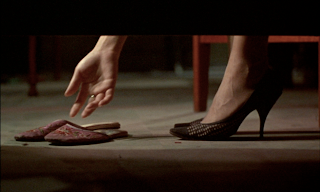
Two images that really struck me as being the most powerful out of the ones at the bottom were 1. The man’s reflection in the mirror image and 2. The women grabbing her shoes and the shot is from under the bed. I feel like in this movie, the visual storytelling was all from the outside’s perspective. All that was being narrated was being narrated from our perspective, as the audience. As she grabbed her shoes, we could see as if we were spying on her. The same with the reflection. We were looking at him from behind just like in scary movies when the guy looks in the mirror and sees the reflection of a murderer or someone in the mirror, you expect them to show someone looking in the mirror at him but then you realize that person is you, the viewer. They are the most powerful because it really helps to demonstrate the sense of voyeurism. As for the connections? Sure, there are connections. With or without sound, this sense of voyeurism would still be present. We feel as if we are peering into their lives just as they feel they have to peer into their spouses because they are cheating. We get a sense of what they are going through which can be delivered with or without sound. We can appreciate the cinematography in that aspect. We clearly feel the way we do throughout the film because of the camera angles and proxemics so sound is not super necessary. We still have the same feeling that we do.
Days of Heaven - James Clarke
The scope of Days of Heaven is so expansive it would seem a lot larger than the story actually is. Though far more complicated than many traditional love stories, the setting is what sets it aside. The tangled love story is set on a beautiful landscape that becomes a profound allegory for harmony and chaos, love and hate, and good and evil. Its emotional impact, and sometimes lack thereof, is caused by the narrator, Bill's sister, who actually has a really terrible accent and diction.The opening titles provides sepia-toned period photos of turn-of-the-century city and rural life. The titles sequence ends with a photo of the narrator that has been sepia-toned to look like the other pictures.Do The Right Thing - James Clarke


If there is one character in this film that bothers me more than any other, it is Buggin Out. If there was a foil to the ignorant and bigoted rednecks of the world, this would be it. The ignorant, poor, and under-informed oppressed guy. Not only do all of the other characters in the film (with the exception of Radio) tell him that he is full of it and needs to do something with his life besides complain, but his sole role in the film is that of the antagonist. Now the worst 'bad guy' in the film is clearly the cop that kills Radio, but I do not think that short part is the antagonist of the story itself. Society often feeds on the voices of those who are the loudest, and Buggin Out is definitely a voice to be heard in the community. He could be a voice for reason, but, like all of the other characters in this domino effect of a storyline, he does not do the right thing. His antagonizing Radio and Sal and the other characters is a key factor in the breakdown at the pizzeria.Sunday, December 5, 2010
In the Mood for Love- Greg Weinstein
For instance, one of the greatest visceral images in the film is the red curtain, which is always swaying in the wind, an act of the heart just as the spouses may or may not be swaying themselves. Just like Pyramus and Thisbe, forbidden to meet except through a wall, as our two lovers are forbidden to act on their desires, even though their spouses have, yet the ecstasy and instensity, built up by the shooting appears to be too much for them. This is paralleled with the seclusion of the cheating spouses' faces and how the audience can never see them, perhaps an illusion to their shame and their secrecies. The same red curtain always swaying back and forth in the wind thus seems to allude to our character's loneliness throughout the film, right up until Chow speaks into the hollow tree and then muddles it up to stay there alone, never to be heard from by anyone else. This loneliness is also displayed in the beginning before Chow and So really meet, as they are both always eating alone, depressed thus leading to their inevitable hookup. This is the defining moment of the film, as the audience knows what should happen, we have seen it so many times in Hollywood movies, where the couple's passion finally erupts into the most sensual scene one can imagine, but this doesn't happen here. The audience never sees this and is thus, left alone at the end of the film without any conclusion or finality to our want of these two lovelorn characters to get together. It is this sympathy for the characters that Wong Kar Wai cleverly and expertly develops throughout the movie, always keeping us on the edge of our seats, just like good movies should.